World Health Day 2026: Technical Training and the Value of Science
 imprimir

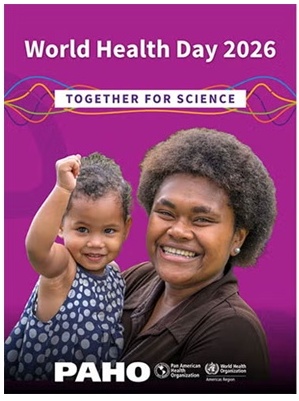
The World Health Organization (WHO) brings in 2026 a global call to value science and collective action to address contemporary health challenges.
In this context, on April 7, World Health Day, RETS reinforces the strategic role of networking and the training of health technicians as fundamental elements for strengthening health systems, especially in regions marked by structural inequalities, such as Latin America and the countries of the Community of Portuguese Language Countries (CPLP).
“Together for health. Stand with science.” celebrates the power of scientific collaboration to protect the health of people, animals, plants, and the planet. The WHO campaign, which runs throughout the year, highlights both scientific achievements and the multilateral cooperation needed to turn evidence into action.
Networking and international cooperation
The complexity of health challenges requires coordinated responses based on networking and international cooperation. Working in networks connects training institutions, managers, and professionals from different countries, promoting the exchange of experiences, knowledge sharing, and the joint development of solutions.
In this context, networks such as the International Network of Health Technicians Education (RETS) play a central role by bringing together strategic actors and strengthening professional health education in different settings. These initiatives contribute to harmonizing training frameworks and strengthening public policies aimed at workforce qualification.
The availability of qualified workers, equitably distributed and prepared to operate at different levels of care, is recognized by international organizations as an essential condition for ensuring universal access to health. In this scenario, technical health training is consolidated as a structuring axis for building resilient systems capable of responding to health emergencies, expanding care, and promoting equity.
In Latin America and within the CPLP space, strengthening networks for technical health training is particularly relevant. These regions share historical challenges such as social inequalities, limited access to health services, and the need to qualify the workforce.
Technical training and the value of science

The training of health technicians is directly linked to the value of science. These professionals are responsible for translating scientific knowledge into concrete practices of care, surveillance, and health promotion. Their work is essential in primary care, specialized services, and responses to health emergencies.
Investing in technical health education therefore means strengthening science in its applied dimension, ensuring that produced knowledge is effectively incorporated into health systems and generates impact on people’s lives.
Moreover, the continuous qualification of these workers contributes to addressing misinformation, one of the main contemporary challenges identified by international organizations. Well-trained professionals act as trusted agents, promoting quality information and strengthening ties with communities.
Paths for the future
Given global and regional challenges, strengthening networks for technical health training and expanding structured cooperation are essential paths forward. Integration among institutions, countries, and regions makes it possible to optimize resources, share solutions, and build more effective and sustainable responses.
In the context of World Health Day 2026, it is reaffirmed that there is no health without qualified workers, no strong systems without cooperation, and no future without science. Investing in the training of health technicians is investing in lives, equity, and sustainable development.
Building a healthier world therefore depends on the ability to act collectively, strengthen networks, and value knowledge as the basis for action..