2nd CPLP Summit Reinforces Commitment to Integrated Health Systems and Cooperation Among Portuguese-Speaking Countries
 imprimir

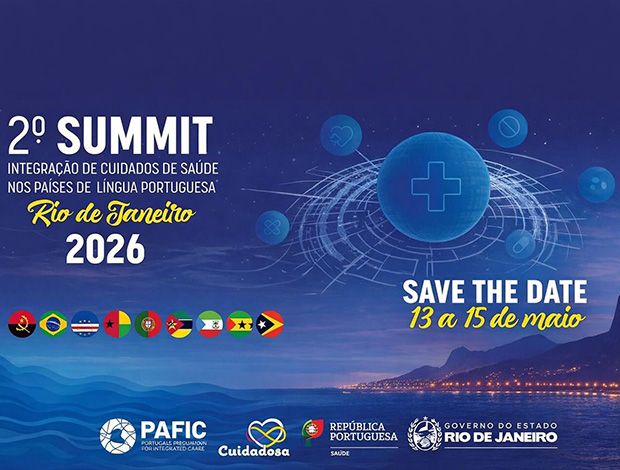
The 2nd Summit on Integrated Health Care in Portuguese-Speaking Countries, held from May 13 to 15, 2026, in Rio de Janeiro, represented an important step forward in strengthening health cooperation among the countries of the Community of Portuguese Language Countries (CPLP). More than a technical meeting, the event established itself as a strategic platform for political, scientific, and institutional dialogue aimed at building more integrated, sustainable, and people-centered health systems.
The scale of the Summit demonstrates its growing relevance on the international stage. Organized by the Portuguese Association for Integrated Care (PAFIC) in partnership with Associação Cuidadosa, the event received institutional support from the Ministries of Health of Brazil and Portugal, the Government of the State of Rio de Janeiro, and the CPLP. The program brought together more than 120 speakers across 28 sessions over three days, involving public health managers, healthcare professionals, researchers, international organizations, and representatives of academic institutions from Portuguese-speaking countries.
Participants included government representatives, integrated care specialists, leaders of health institutions, experts from the World Health Organization (WHO), and authorities linked to the national health systems of CPLP member states. WHO played an active role in technical panels, side sessions, and knowledge-sharing activities, highlighting experiences related to the ICOPE (Integrated Care for Older People) strategy, which seeks to reorganize health systems to address population ageing through continuous, integrated, and person-centered care.
One of the Summit’s most significant achievements was the consolidation of integrated care as a key guiding principle for health policies across the Portuguese-speaking world. Discussions emphasized the need to overcome fragmented service delivery and strengthen coordination among primary care, specialized care, social services, and long-term care. The approach promoted throughout the event was based on the so-called “4Cs of Integration”: continuity, coordination, person-centeredness, and community engagement.
Population ageing emerged as one of the central themes. Brazilian authorities highlighted that rapid demographic change will require health systems to be better prepared to address chronic diseases, functional dependency, and growing demands for long-term care. In this context, the Summit reinforced the importance of reorganizing care models to ensure greater efficiency, quality of care, and financial sustainability of public health systems.
Another important aspect was the emphasis placed on knowledge production and innovation. The event encouraged the presentation of research projects, intervention initiatives, local experiences, and technological solutions aimed at advancing integrated care. Dedicated spaces were also created for the dissemination of best practices and the recognition of innovative projects in integrated health care, further strengthening technical exchange among participating countries.
From a political and institutional perspective, one of the Summit’s main outcomes was the strengthening of a collaborative network for integrated care within the CPLP. Participating countries reaffirmed the commitments established in the Lisbon Charter of 2025 and advanced a shared agenda through the signing of the Rio de Janeiro Commitment Charter 2026, a document that outlines guidelines for accelerating the transformation of health and social protection systems across Portuguese-speaking countries.
Among the main post-event commitments and follow-up actions are:
- strengthening technical cooperation among CPLP countries in the field of integrated care;
- developing permanent networks for the exchange of experiences and best practices;
- expanding strategies focused on healthy ageing and long-term care;
- promoting public policies centered on people and communities;
- encouraging care models that integrate health and social services;
- fostering joint scientific production and the dissemination of evidence to support health decision-making;
- strengthening the education and training of the health workforce to operate within integrated care models;
- incorporating integrated care principles into national health plans of participating countries.
The Summit also reinforced priorities already established in the CPLP Strategic Health Cooperation Plan 2023–2027, particularly those related to strengthening national health systems and developing the health workforce. In this regard, the event directly contributed to ongoing discussions on professional education, the training of health technicians, continuing professional development, and the organization of multidisciplinary teams capable of working in an integrated manner across different levels of care.
Overall, the event demonstrated that health cooperation within the Portuguese-speaking community is gaining greater institutional depth and international relevance. By bringing together different countries around shared challenges and collective solutions, the 2nd Summit consolidated integrated care as a strategic priority for the CPLP and strengthened the development of a community of practice capable of contributing to more resilient, inclusive, and future-ready health systems in the face of demographic, epidemiological, and social transformations.