EPSJV hosts the first meeting of the Webinar Series on scientific initiation and health technical training in Latin America
 imprimir

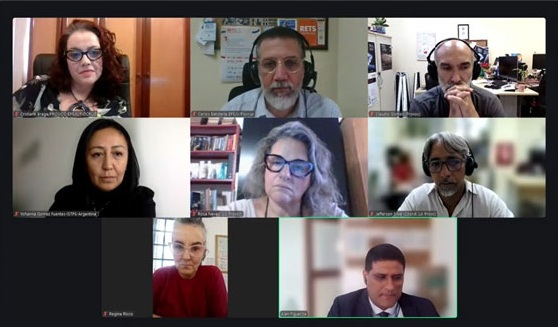 The Joaquim Venâncio Polytechnic School of Health (EPSJV/Fiocruz) held, on May 15, the first meeting of the "2026-2028 Webinar Series - Scientific Initiation of Youth in Basic Education and in the Training of Health Technicians in Latin America". The initiative seeks to promote dialogue among researchers and professionals who work in the training of youth and health technicians in the member countries of the Ibero-American Network of Health Technician Education (Riets) and is part of the activities planned in the 2024-2028 Work Plan of EPSJV as a Pan American Health Organization/World Health Organization Collaborating Center for Health Technician Education.
First Meeting
During the first meeting, discussions addressed the possible contributions of scientific vocation programs to health training. The activity took place at a symbolic moment for the Polytechnic School, which celebrates the 40th anniversary of the Scientific Vocation Program (Provoc) at Fiocruz, a pioneering initiative in Brazil aimed at the scientific initiation of high school students.
 Created by EPSJV, Provoc has become a national reference in promoting scientific initiation among youth, inspiring similar experiences in different research and teaching institutions in the country. Over four decades, the program has been strengthening the connection between basic education, science, and health, contributing to the critical and scientific training of students.
At the opening, the coordinator of the Laboratory of Scientific Initiation in Basic Education (Lic-Provoc), Jefferson Almeida, and the coordinator of International Cooperation at EPSJV, Carlos Batistella, welcomed the attendees and explained the dynamics of the meeting.
Next, there was a presentation by professor-researcher Cristiane Braga, who coordinates Provoc at EPSJV. She explained that the program has been offered since 1986, articulating Fiocruz's scientific research institutes with educational institutions, promoting the scientific initiation of high school students. “Our goal is to introduce young students to the scientific production environment for the observation and development of scientific practices specific to different fields of knowledge, including the study and debate of reference bibliography and participation in scientific events for presentation and dialogue about scientific production,” she highlighted.
What Provoc seeks, according to the coordinator, is to awaken in youth an interest in scientific research, understanding the critique that many of them will not pursue careers as scientists and researchers. “We start from the premise that young people cannot choose what they do not know. So, we need to provide access to initiatives like this so that, from this experimentation, they can have the possibility to dream of pursuing the field or not,” she commented, citing three other objectives of the program: “To give students the opportunity to develop scientific work, integrating theory and practice; to help them make more conscious professional choices and, thus, also contribute to a process of integral formation.”
In her speech, Cristiane pointed out that about 3,500 students have participated in the initiative since its creation. She highlighted that, in 2024, the latest institutional report indicated the incorporation of 807 workers into the research career at Fiocruz. “Since 2022, with the advancement of the nationalization process of Provoc, we have recorded the entry of approximately 140 students per year in the Initiation Stage and another 80 in the Advanced Stage,” she stated.
Cristiane also emphasized the diversity of knowledge areas involved in the research developed by Fiocruz. According to her, in 2023, the institution had 30 research areas, linked to 323 lines of investigation and about a thousand ongoing projects. Currently, Fiocruz has 16 technical-scientific units focused on research, teaching, innovation, assistance, and technological development in health. In addition to the units located in Rio de Janeiro, the institution maintains a presence in the five regions of the country, operating in 11 Brazilian states. The coordinator also noted that, since 2022, Provoc began operating in a national network, through the Luiz Fernando Rocha Ferreira da Silva Provoc Network. “Today, the Provoc Network brings together Fiocruz research units in ten Brazilian states and articulates partnerships with 30 educational institutions, mainly basic education schools, in addition to social organizations focused on education located in territories near the Fiocruz campus in Rio de Janeiro,” she explained.
Expansion of Provoc
 Next, EPSJV professor-researcher Rosa Neves presented the diffusion of the Provoc model to other institutions. According to her, in the late 1990s, the model was expanded to Fiocruz units in the states of Minas Gerais, Pernambuco, and Bahia. “In that same period, the model was adopted by research institutions in areas of knowledge beyond health, in Rio de Janeiro, such as the Brazilian Center for Physics Research, the Leopoldo Américo Miguez de Mello Research, Development and Innovation Center, the Pontifical Catholic University of Rio de Janeiro, and the Institute for Pure and Applied Mathematics,” she said.
Rosa also recalled that, in 2003, the "Junior Scientific Initiation" funding modality was created by the National Council for Scientific and Technological Development—the federal agency responsible for centralizing investments in Science and Technology in Brazil, which, according to her, contributed to the national expansion of scientific initiation aimed at high school students. “And with this, there was also the creation of other programs directed at the same audience, called scientific initiation, but with different ways of approaching basic education students to the sciences, mainly through olympiads and science fairs,” the professor-researcher stated, adding that in 2010, the Institutional Quota Program for Scientific Initiation Scholarships in High School (PIBIC-EM) was created, guided by a concept of scientific initiation similar to that of Provoc.
 Finally, the professor-researcher at the Polytechnic School, Claudio Gomes, returned to the central objective of the meeting: to discuss the possibility of the Provoc scientific initiation model inspiring experiences aimed at training health technicians in Riets member countries. “Given what was presented earlier, we would like to know the representatives' opinions on a possible positive relationship between the Provoc proposal and dynamics and the training of health technicians in their countries. What would be the interests, possibilities, and challenges for adapting the Provoc model to the training of health technicians in your countries or, more broadly, in Latin America?” he asked, opening the debate with some Riets members. He then concluded the discussion by highlighting that scientific initiation for health technicians also involves a broader reflection on the scientific references adopted: “The question and the justification about doing scientific initiation for technicians also go through the question and the answer about which science we are referencing.”